Friday, December 13, 2019

Yearnings


Yearnings

Dec. 13, 2019


We all experience longing, especially around the “holidays.”


Who has not lived, and successfully managed to escape ever wanting a particular thing? Perhaps the sudden sounds of soppy, silly music and appearance of decorations exhorting us to be happy and buy everything in sight propel us into the murky, sentimental and elusive past. In any case, there is introspection.


And contrary to the once popular, super modernist film master Bunel (please do not forget the tilda on the “n!”) “The Obscure Object of Desire” is in truth usually not that obscure but quite identifiable, often in the simplest of ways: the universal quest at bottom always is a longing for immortality. Because upon achieving whatever it is that beckons, you invariably want the next thing.


As I pointed out to a class in an effort to get them to read and appreciate the Epic of Gilgamesh, the reason for the four thousand year old hero’s obsessive fear of death and ensuing quest for eternal life is simple: why do your homework if you know that one day you’re gonna die? Wouldn’t it be better not, thus making all your toil and efforts more meaningful as you meet each day? Gilgamesh, one of the earliest, recorded neurotics of stature in the western canon, concrete and literal of thought though he was, still can impress. It's the quest, of course!


So now that we’ve established the purpose of yearning- that of always seeking immortality- be it through shopping, food, drugs, screen time, human connections, exercise, gambling, constant travel or moving about, sugary confections or a potato chip addiction, I’ll share one of my own particular quests.


In the past I’ve wished to be a writer of towering import, as mesmerizing, precise, accurate and compelling as Dreiser and James, emotionally suspenseful and page-turning as Charlotte Bronte, brilliantly witty as Austen, enduring a chronicler of my times as Wharton, slick as Pynchon, poetic as Woolf, clever as Calvino and so much more. When people still eagerly are devouring my books a hundred years hence, they will be transported back into the cultural miasma of the latter twentieth and early twenty-first centuries, in bold colors! A labyrinth of pictographs my words have created propelling the readers' imaginations speeding through time and lusting for more of my work.


Was this really too much to ask for?


Well, now I’m not so sure. . . . In any case, there is the blog.


And your yearnings?


Friday, November 29, 2019

Things to Do on a Long Flight

Here are some of the things you can do to pass the time on a six hour flight.

For the first half hour or so you are busy "settling in" as you wait excitedly to taxi to the runway. This includes hoisting a heavy, overpacked roll-y, stuffed with clothes you may never wear, into the overhead without injuring your back, sitting and trying to get comfortble. There's also fiddling with the seat belt, squishing your nice coat and previously spiffy carry-on into the dark, dirty space on a carpet beneath your feet and checking out neighbors.The captain cheerily announces a "brief delay" and it no longer feels exciting.

Since it's usually a seven or eight a.m. "departure"- which means (if you count backwards) you've been up since three something- you are determined to sleep for the first few hours, which almost never happens. You writhe your weary, sleep deprived body into a consciousness blocking, soothing place that totally does not block light, noise or consciousness.

After an hour or so of pretending to "sleep," you "wake" and inquire about the time, at which point you find out you have not completed yet a fifth of the journey. You continue to down as much water as possible to avoid dehydration.

Heading for the bathroom and while waiting for the occupied, claustrophobic little closet to become available, you have a brief but intense conversation with a curious fight attendant who seems mesmerized by the tiny, across-the-body Baggalini you wear. She asks if she can see how the little compartments work. The door opens and you slither sideways into the tiny space.

Returning to your seat you go through your carry-on somewhat wildly looking for something you may have forgotten. Everything is in small, Ziploc bags yet still basically unidentifiable. It's discouraging.

Free floating and un-Ziplocked items in the bag reveal a crumpled scarf, a now creased folder, a couple of pens, a pad, a book, two hair clips, tissue packets, loose hard candies; the process of pawing through the stuff is excruciating. You do not find what you are looking for and have forgotten what it was, but make a mental note to check for it again later. 

Staring intermittently at the book you brought occupies a few unhappy minutes before you decide to search for a movie. The airline film "library" is mainly Disney-ugh along with other made-for-video really bad movies, but you refuse to go it alone and pay for wi-fi, and in any case your "device" is way too small. You go through the menu twice and decide it's time for the bathroom again. It's so important to stay hydrated, you remind yourself, even though this means constantly having to pee in a contorted pose, in a teeny closet that presages being really, really careful; by now your eyes are burning crazily from the dry, recycled air.

You begin this little diary, madly scribbling a few notes, then start the whole idiotic process again: rummaging through the carry-on; going to the bathroom; staring into space; refusing to read your book; more staring; looking at the movie menu in utter disgust; going to the bathroom . . . .

Three hours finally have passed although you have no idea by now what the real time is and may be beyond caring. In any event, you will have the chance to repeat the entire process of rummaging, staring, cursing at the movie menu, staring, wondering if the other passengers are going through the same thing or just have taken drugs, staring, and peeing in a most uncomfortable position at least three more times, and possibly more.

By the time you arrive you are more exhausted than ever dreamed, and the soul crushing, beaten down, nihilistic feeling that began shortly after boarding has permeated almost every cell; but as you prepare for landing  (what will that be like this time? Such episodes from air to ground vary from relatively "smooth" to unbelievably white knuckle) you vow to buck up, drag yourself and all your stuff down that crowded, narrow aisle, and onward!


Thursday, October 31, 2019

Reader Responses to Harold Bloom

Reader responses to the post about literary/cultural critic Harold Bloom, with comments and links to other articles.

FROM PAULA T., COMMENT

 I have enjoyed reading Bloom’s criticism over the years particularly because it was thoroughly readable and understandable - a negative to some academics. As far as his prediction of the path academia would take it seems he was spot on. Even when my kids went to college they weren't required to take survey courses. Instead of broadening the canon his critics seem to have narrowed it down into specialties much like medicine. The generalist is a thing of the past. . . read criticism sporadically, never evaluating it, just kind of happy to find something stimulating about some book i was interested in. Every time I visit Renee in Monterrey i read a bit of her copy of Genius just to see what he says about Henry James. He approves. Bloom included Colette in one of his many great writers lists. I approve .He wrote so many damned books I can’t keep track.

I thought he looked more than a bit like Eeyore, but then I adore Eeyore. He was absolutely brilliant and much maligned. He just wasn't PC. In the 80s, when my children informed me that survey literature courses were no longer required, I was appalled. They seemed to go straight through to what I would call electives! I believe a background in great literature should be required.  Isn't it possible to expand literature without throwing the proverbial baby out. Couldn’t world literature be the requirement rather than allowing students to take isolated courses in whatever.  I am so saddened by the the disappearance of the liberal arts. It seems to be something for the elite and even they have to make sure to study what will result in a high income. Bloom certainly was right.

Excellent op ed in today’s Times [Did Harold Bloom or Toni Morrison Win the Literary Canon Wars] arguing that they both won and both lost due to the decline in liberal studies, brought about, I think, by the escalating costs of higher education. Nice way to keep the economy tipped toward the top.

                                             . . . . . . . . . .


FROM DANA, A LINK TO A STORY ABOUT BLOOM'S EARLY ROOTS AND JOURNEY
  

                                         . . . . . . . . . . .

FROM NOAH G., COMMENT & LINK TO A GUARDIAN ARTICLE CHARACTERIZING BLOOM AS "A CRITIC WHO POLARISED OPINION"

Interesting article: Harold Bloom was right to extol great literature, but was often blind to who was neglected.

https://www.theguardian.com/commentisfree/2019/oct/20/harold-bloom-defence-of-western-greats-blinded-him-to-other-cultures?CMP=Share_AndroidApp_Copy_to_clipboard

                                     . . . . . . . . . . . .
                                      

FROM KARLAN, COMMENT
Thanks.  I had skimmed the obit and am glad I read it now more thoroughly.  His prediction seems unlikely to me.  It would be good to discuss with current English majors.  
                                            . . . . . . . . . . .


From Storyweaver: How many college students choose English or liberal arts as majors? More generally, do people know what they're missing if they don't read the classics, in or out of the "canon?" Is it really easier and more convenient just to go with the media flow of comforting/distracting sounds, settings, one line "ideas. . . ?"

Friday, October 18, 2019

Harold Whom? Harold Bloom!!


Just to note: a friend pointed out quite accurately that everyone is now writing an essay about Harold Bloom; please be assured this is not an essay but a blog rant.

 Anyone who likes Northrop Frye cannot be all bad.
  
Harold Bloom, scholar, teacher, critic, writer, thinker, was a literary giant of the ol' style literature and else-wise Patriarchy, a man who in a Paris Review article was said to repeatedly call a grad student "my dear" while deriding her analysis of a major Shakespearean villain. He was a defender of the Western canon, most likely a huge male chauvinist, a purveyor of controversy. He also was a brilliant, far thinking, unique, innovative and analytic mind and critic; and for all this, he can be forgiven almost anything.

In addition, Harold Bloom apparently really liked one of my own more arcane literary heroes, Northrop Frye (go look him up, if you are not familiar- dare to find out who's behind the daunting moniker "Northrup" followed by the very Brrrritish "Frye," a name in itself to inspire serious, old school English lit awe, with intimations of perhaps the Beowulf era and the mindless, happy gulping of mead for breakfast).  Bloom also took on the once hallowed (now antediluvian) "new critics" literary mafia and defended the Romantic movement. For these things he shall be forgiven his transgresses, even in our multicultural, post post feminist, post post post post everything social and cultural milieu.

Bloom was the archetypal son of immigrants who caught his star by seizing the educational green light at the end of Daisy's dock, with the distant flicker of success beckoning more modestly, as Master Teacher rather than Master of the Universe; he achieved it through hard work and an amazing talent. He had his critics, and needless to say, like many of us, he was not a perfect human. However he was a gift to anyone who likes well constructed words and ideas and was  influential, entertaining, and a first class literary and cultural trouble maker. How can we not cleave to that?

Not sure how many blog readers know Bloom, or even care to look more closely, but honestly, it's worth a try, whaddya got to lose?? Two well known works among his unbelievably prodigious output on literature, culture, history are "The Book of J" and "The Western Canon." I cite these two only because they quickly come to mind and thus preclude having to dive online and do research to jog the memory- my own laziness here sadly providing yet more evidence for Bloom's lament about the decline of modern thought processes! In truth he wrote tons of great, often illuminating essays on lit and culture, and his ideas on Shakespeare are among the best; his take Hamlet is worth checking out for anyone mildly acquainted with the late Dane.

Did Bloom's preferred canon have significant omissions, and was he too much "then" and not totally in step with the times? For sure! The world always moves on and he left out names and works that should not have been excluded, and included  others with which you may not agree. But he created a major point of reference, a framework from where to start, a codified collection of suggestions, and a history. 

More significantly the canon, unlike the four thousand year old Gilgamesh- the ancient epic's eponymous main character often regarded as the first tragic hero- is not written in stone on rock tablets in cuneiform; it is fluid. And whether fluid or concrete, it's never the last word but a starting point, an idea. 

Perhaps Bloom just reminds me of my own youthful dalliances with serious lit, and therefore my youth, but this in no way negates the importance of what he offered. He also made his knowledge accessible to all kinds of readers, not just scholars and intellectual snobs, and then was criticized for popularizing such rarefied subjects.  

Would I have liked him personally? Who knows. . . .Why should we care about him? Well, why not? He counts. Times  change, but as Proust reminds, some things perennially remain. . . . The guy definitely knew his stuff, and lots of it. If you are one who likes to read, and read things that make you think carefully about what you just read, then read him too if the spirit moves you, and decide for yourself.

This excerpt from the Times obit states Bloom's credo in his own words:“What are now called ‘Departments of English’ will be renamed departments of ‘Cultural Studies,’” he wrote in “The Western Canon,” “where Batman comics, Mormon theme parks, television, movies and rock will replace Chaucer, Shakespeare, Milton, Wordsworth and Wallace Stevens. “Major, once-elitist universities and colleges,” he continued, “will still offer a few courses in Shakespeare, Milton and their peers, but these will be taught by departments of three or four scholars, equivalent to teachers of ancient Greek and Latin.” 
  
Oy, a veritable Literary Armageddon! But wherever you stand on what should be included (or not) in the canon going forward or editing backward, clearly you don't have to love everything in Bloom's version of what's essential to get the sense of what he is saying about his choice of great works; and I won't apologize for not particularly adoring Wallace Stevens or numbering Wordsworth among my favorite Romantics, but does this really matter?
  
The reactions to Bloom's quotation that came back via email before writing this blog surprisingly and not surprisingly showed me that readers from various and divergent points on the cultural/political spectrum seem to agree on certain basic issues and ideas inherent in his work, rationale, and contribution.

Next time on the blog I will post comments from readers along with email responses to Bloom's vision.  Are we truly headed toward one, gigantic, prose, poetry, art (and everything else that counts) theme park of culture? Maybe we're already (more than?) halfway there? Or not. Let us know what you think, and tune in to next post to see what others say about the direction of the canon, writing, critical reading and all art forms in general, the notion of "culture," and our own culture: the way we live, think, believe, observe and experience.

Friday, October 4, 2019

Small Pleasures, "Happiness. . . ."

I've written of my obsession with books, often in highly opinionated discussions of particular stories that have made it to my very own "favorites" list of beloved reads; going so far as to brazenly suggest that everyone else in the world should and must read and love these works too. 

Such extreme pickiness and solipsism have led me on occasion to throw up my hands at the failure to find a really good read, then over romanticize the past, and finally to fall back on, or into, the nineteenth century (lack of antibiotics but lots of horse manure in the evocative, sepia tinged, city streets notwithstanding!)-  usually in moments of reading despair; it's the kind of hopelessness that clouds one's thoughts after perusing more than a few of those speedily churned out, unfulfilling narratives (of sorts) by folks barely out of their teens; non-entrancing novels arranged on "featured" (or "new in paperback") tables near the front entrance of book stores.

Finally, after desultorily (how's that for a 19th c. word?!?) trying to finish reading what seemed like dozens of boring or just plain ol' silly books this year- although in truth it probably totaled no more than ten or maybe fifteen- some of which were reviewed by smarmy literary periodicals but as it turned out, so what?- I hit pay dirt! For one sweet moment the "find" seemed to make the hours spent trudging through all those other inconsequential pages almost worth it. 

The book's only fault was that it was too brief, almost a novella though not quite. Honestly, I loved it so much I started rereading the whole thing again from scratch days after I finished it. Just wasn't ready to let it go, using the justification for this clingy behavior that perhaps I had missed some incredible gem of phrase or idea the first time around. I mean, who doesn't miss a few subtle sparks of wonderment when you first delve into a book you know almost  immediately you will love and cherish? Happily though, a novel can be read twice, or twenty times. If it were a charlotte russe on the other hand, you would have to buy two. . . or three. . . . Another good reason to gobble books over the years as opposed to, say, charlotte russes.

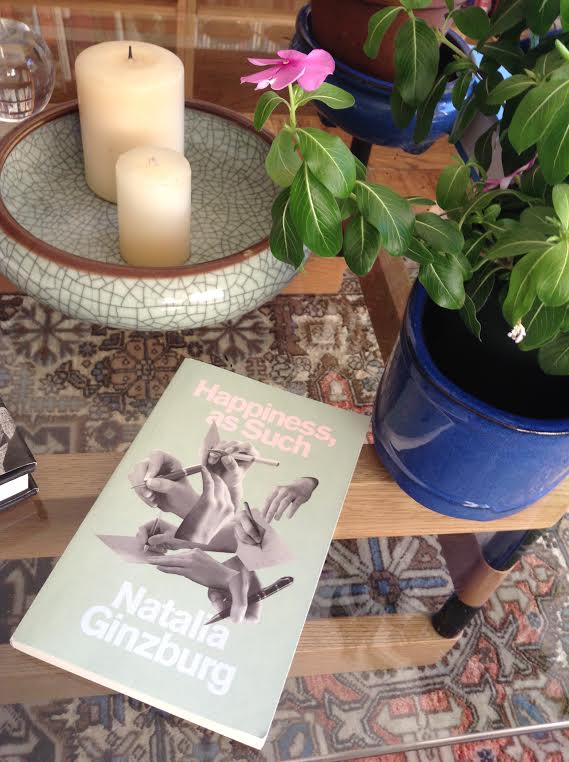
Ironically because the story imbued so much reading happiness even though it's not especially a happy go lucky kinda' tale, the very title of this wise little book doubly amazed: Happiness as Such by mid-20th century Italian writer, Natalia Ginzburg. Through an especially skillful translation, Ginzburg's powerful, spare use of language in succinctly getting to the heart of everything only adds to the pleasure of meeting her characters, hearing their story. The book also happens to be an "epistolary" novel comprised mainly of letters- another technique of uneven success sometimes assigned to nineteenth century women authors, and not always flatteringly. But here it worked. The author created a super sharp image with just a few well placed clicks of the shutter.

In fact, it's hard to imagine this fantastic work being written in any other way. It's so perfect it almost dares you to ever try to write another word, even a shopping list. 

Now I'm rereading the author's entire (you should pardon the expression) oeuvre (which I definitely am not suggesting anyone must or should do); I'll settle instead for insisting you read this newly translated and published exquisite, little novel.

In return, should you be moved to recommend anything you recently fell head over heels with in reading enchantment, let's post it!

Friday, September 13, 2019

Going Paperless

NO. NO. A THOUSAND TIMES NOOOOOOO!

Going paperless.

Anyone who suggests this has reached an advanced state of hopeless madness.

And yet when someone announces (often quite proudly, if not downright smugly) that they're actually doing this, it prompts a morbid curiosity.

Putting all your stuff in the invisible world, you know, everything, the sum total of every phone number you ever may need, the record of every dollar you've ever sweated for, the file of each and every single transaction that affects your life-  usually in significant ways!- is just plain crazy.

In addition, when carried to the full extent of its words, basically this also means not only paying all your bills in the great, wild west of virtual reality- as convenient as first this may seem- but never, ever touching another sheet of real paper again, be it the page of a book or magazine, a cherished card or letter, a lined yellow note pad, a sticky note, a smooth, glossy photograph. . . you get the idea.

Honestly, it's beyond crazy. It's completely and irretrievably, ineluctably insane.

My fondest wish is to be so relaxed and other worldly that I actually can do this one day; then I regain my senses.

Going paperless. You know, like exploring the fourth dimension, or doing time travel. Or maybe communicating with ghosts at a seance.

I just have not reached that level of total insanity yet, tempting though at various times it does seem. . . .

A kind of Grand Illusion.  A phantasmagorical chimera.

Going paperless.

A dream from which eventually I always awake.

Maybe next year.